
President Pranab Mukherjee, Prime Minister Narendra Modi, Vice President Hamid Ansari, Union ministers, Congress President Sonia Gandhi, Rahul Gandhi and various other top leaders have condoled Tamil Nadu Chief Minister J Jayalalithaa's demise and paid glowing tributes to her.
'Modi swept the 2014 elections for two main reasons: First, the disgust with the Congress government with a non-functional prime minister, and second, more importantly, his promise of performance and hope.' 'He cannot expect to win 2019 on these planks again. His own success in finishing the Congress will take away one plank, and with five years of reign on his CV, he will need to flaunt performance more than promise.'

Given the twin embarrassments of a TTV win and party nominee Karu Nagarajan losing his deposit, polling fewer votes than NOTA, Prime Minister Narendra Modi and BJP boss Amit Shah would be pushed to rethink their strategy. Tamil Nadu would thus become a part of the BJP's grander strategy for 2019 rather than a stand-alone affair, says N Sathiya Moorthy.

'Competence, experience, matter, did you say?' 'No music was sweeter than the mash of xenophobia, jingoism, racism, misogyny.' 'And the master busker to play the tune was round the corner to capture an eager audience just in the nick of time.' Shreekant Sambrani on the Trump Triumph a week after his upset victory.

'The BJP portrays a make believe world.' 'The Tripura victory is being seen by some as a result of bahubal and money power -- but that would be a very simplistic explanation.' 'Money and muscle power can play a role up to a point, but the BJP's victory is remarkable because it replaced a party that was in power for 25 years.'
'Sonia Gandhi can't rejuvenate the party, her heir is fodder for stand-up comedians, and nobody in the Congress has the guts to question the Nehru-Gandhis.'

'Tying somebody to the jeep is not the military way, but the officer was able to come out of the situation without any bloodshed.' 'I am not supporting him, but I am also not criticising him.' 'He had to use some mechanism to save the uniformed personnel, many of whom were Kashmiri boys of the J&K police,' points out Lieutenant General D B Shekatkar (retd), who was instrumental in the surrender of a record 1,267 terrorists in Kashmir.

'The Kopardi rape/murder was the immediate cause of the unrest.' 'However, there is a feeling of isolation and anger that has been simmering within the Maratha community.' 'The protests gave Marathas a sense of belonging.' 'They felt they have a stake in the protests and the issues being raised.' 'As for the future, let us see what happens.' 'All I can say is it will not stop here.'
'Manmohan Singh was blamed for administrative paralysis, but if you speak to any senior bureaucrat today, they are very bitter and say that files do not move. I am told that more than a thousand files are awaiting clearance.'

In Muthuvel Karunanidhi's passing, Tamil Nadu has lost the last of its Titans.

'They are not affected by ISIS' sentiment of avenging the suffering of the global ummah.' 'They have a huge ummah of their own in India, a huge Muslim population.' 'And because of that, they have to take into consideration the political and social conditions of Muslims in India.' 'They have to express themselves in a more political way and not through terrorism.'
The post mandate comments that 'darkness has descended on India' shows the kind of opposition Modi has to overcome. It is this aspirational India that is attempting to throw away shackles of Macualayism. Make no mistake it is a tectonic shift and a beginning of the end of Maculayan mindset that has 'ruled' India for close to 60 years, says Colonel (retd) Anil Athale.

'The voter thinks that the State is not going to impartially deliver services, provide justice, basic law and order, social insurance -- so as a voter it's very rational that I may choose a criminal who will help me navigate the State.' 'A weak State allows a criminal politician to be the person who provides that guarantee to mediate whatever problem the citizen has with the State.'
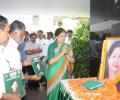
Despite the BJP's displeasure over Sasikala's elevation as AIADMK general secretary, the Dravidian party has sent a message to the Modi government that it will not be cowed down, says N Sathiya Moorthy.

Stakes are high for senior Congress leader Narayan Rane, who is facing a resurgent Shiv Sena on his home turf in Maharashtra's Sindhudurg district, where he is contesting the assembly polls along with his son Nitesh.
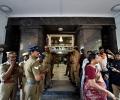
In private, AIADMK spokespersons say that the raid on Chief Secretary P Ramamohana Rao might be aimed at weakening the AIADMK, and demotivating the party from selecting/electing Jayalalithaa's confidante, Sasikala Natarajan, as her successor -- first as party head then possibly in the government, says N Sathiya Moorthy.

Why does the army remain embroiled in counter-insurgency, denying itself a peace dividend even after expending blood and treasure in imposing calm?

'I felt like a used and discarded rag.' 'The pro-dialogue constituency has shrunk in the valley.' Academician and author Dr Radha Kumar was among the three interlocutors which the Manmohan Singh-led UPA government appointed on Kashmir in October 2010, speaks of how the panel report was never acted upon.

Rediff.com reproduces the translation of the remarks made by President Ashraf Ghani at a press conference.
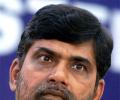
The truth is not that Chandrababu Naidu's centre-right policies led to his defeat but rather almost the reverse: his defeat, and for that matter that of the NDA at the Centre, was widely -- but falsely -- interpreted as a rejection of their economic policies, rather than put down to bad luck and conventional anti-incumbency., say Vivek Dehejia and Rupa Subramanya.

'Our Indian culture system is very family oriented.' 'We value and respect the decisions of our parents to a great extent.' 'That can be a pro or con.' 'It's up to the parents to gauge how much motivation, pressure or space a child needs.' 'Every child is different.' 'We are all unique and that is what I intend to drive home to parents.'

'The US wants Modi to succeed because we want India to succeed. For our part, when India thinks of its partners in the world, we want it to think of the US first. That means positioning our country as the preferred provider of the key inputs that can help to propel India's rise.' 'The meeting between Modi and Obama is, and must be, an opportunity for true strategic dialogue -- not a scripted exchange of talking points, but an open discussion of the big questions. What kind of world do we want to live in? What are our true priorities? And most importantly, why does this partnership still matter?'

The Indian Spring represented by Anna Hazare's anti-corruption campaign, which has culminated in the Aam Aadmi Party's impressive electoral debut in New Delhi, began around the same time as the Arab Spring in 2011 but they led to different outcomes in India and the Arab world, says Ramesh Ramachandran.

After weighing all the costs and benefits, the next administration is likely to reduce and restructure assistance to Pakistan but not to end it altogether, says Daniel S Markey.

With Beijing having had a profound rethink on India's admission as a full member of the Shanghai Cooperation Organisation, the tectonic plates of the geopolitics of a massive swathe of the planet stretching from the Asia-Pacific to West Asia are dramatically shifting. That grating noise in the Central Asian steppes will be heard far and wide -- as far as North America, says Ambassador M K Bhadrakumar.

Arun Jaitley and Janardan Dwivedi have rewritten the rules of politics in the Age of the Internet and its young and restless user base, reports Rediff.com's Sheela Bhatt.

'The BJP used to be a party of decent, Hindu, middle-class people. Today, it is a party of goons. At the ground level, goons beat you up and at the senior level, the intellectuals justify the beating up.' 'On May 13, one boy sent me an SMS at 2.35 am: "Mayank sir, only five seats, what will happen?" There will be a lot of these idealist kids who want that quick transformation that may not happen. We will have to mentor them. We will have to explain to them that nations cannot be changed like that.' Aam Aadmi Party leader Mayank Gandhi, on the lessons the party has learnt from Election 2014.
 © 2026 Rediff.com - Advertise with us - Disclaimer - Privacy Policy - Sitemap - Feedback - About us - Terms of use - Grievances